
Article Brief
Learn why leads go cold and how to build a practical lead follow up system using CRM clarity, automation, AI workflows, scripts, reporting, and better sales handoffs.
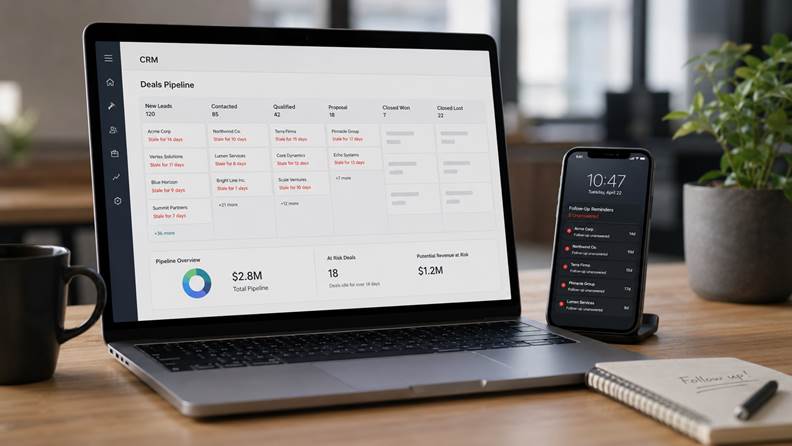
CRM dashboard showing stale leads, follow-up reminders, and pipeline risk inside a lead follow-up system.
A lead does not usually go cold because they suddenly lost interest, changed identity, and moved to a cabin without Wi-Fi. Usually, they go cold because the follow-up was slow, vague, inconsistent, or trapped inside someone’s inbox where hope goes to nap. A good lead follow up system fixes that by turning every new enquiry into a clear next step: capture, qualify, route, follow up, measure, and improve.
Let’s keep this simple. A growing company does not need more random reminders. It needs a system. MoreTech Global’s growth systems built end-to-end positioning is useful here because the problem is rarely just “we forgot to email them.” The real problem is usually the messy space between marketing, sales, CRM, automation, and reporting.
Here is the honest part: if your team has to remember every follow-up manually, your system is not a system. It is a group memory exercise. And group memory is charming at birthdays, not in sales operations.
The Problem: Leads Get Cold in the Gaps
Most companies do not have a lead problem first. They have a follow-up gap. Someone fills out a form, asks for a quote, books a call, visits a pricing page, downloads a resource, walks past your trade show booth, or sends a message after seeing an ad. Then the business responds… eventually. Sometimes. Depending on who saw the notification, who was in a meeting, and whether the spreadsheet decided to behave.
That is where leads cool down. Not because the buyer is unreasonable. Because the buyer is busy. They may be comparing three vendors, waiting for a clear answer, or simply forgetting why they clicked in the first place. MoreTech Global talks about better follow-up and conversion as part of its growth-system approach because speed only matters when it is connected to clarity.
Harvard Business Review’s classic research on online sales leads found that many companies were not responding nearly fast enough, and later lead response studies are still built around the same uncomfortable truth: fast, relevant follow-up wins attention before the buyer’s interest goes soft. RAIN Group also reports that generating meetings often takes multiple touchpoints, with top performers needing fewer because each touch adds value. The practical lesson is not “annoy people eight times.” Please don’t. The lesson is that follow-up needs rhythm, relevance, and ownership.
What Is a Lead Follow Up System?
A lead follow up system is the process, technology, and team habit that makes sure every lead gets the right response at the right time. It usually combines CRM stages, automated reminders, email nurture, sales tasks, lead scoring, reporting, and clear handoff rules.
Think of it like this: a lead follow-up system is not one email template. It is the kitchen behind the restaurant. The customer sees the meal. Behind the scenes, someone needs the order, the timing, the ingredients, the chef, the waiter, and the bill to all work together. Otherwise, everyone gets soup at dessert.
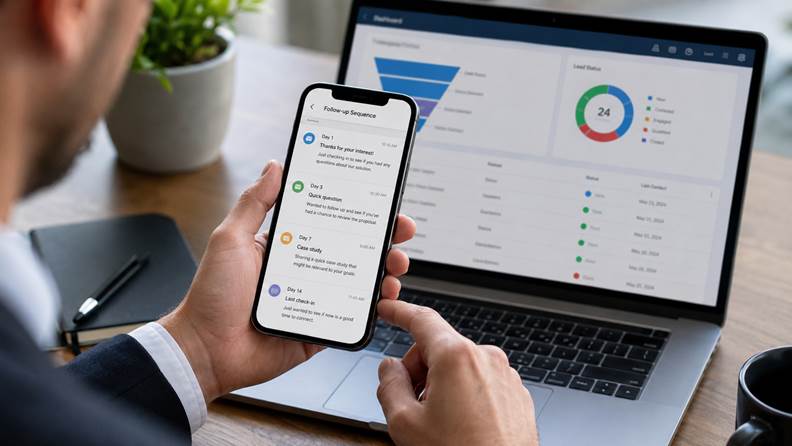
Caption: A follow-up sequence works best when messages, CRM stages, and reminders are connected—not scattered across tools.
A simple system should answer these questions:
- Where did the lead come from?
- What did the person ask for?
- How fast should the first response happen?
- Who owns the next action?
- What message should they receive next?
- When should automation stop and a human step in?
- How do we know whether the follow-up worked?
This is why a strong CRM + pipeline clarity setup matters. Without clear stages and ownership, every lead becomes a small detective story. Nobody wants Sherlock Holmes managing a sales pipeline at 4:55 PM on a Friday.
Manual Follow-Up vs Automated Lead Follow-Up
Manual follow-up is not bad. In fact, human conversation is still where trust is built. The mistake most people make is expecting humans to remember every repetitive step while also selling, serving customers, writing proposals, joining calls, and occasionally eating lunch like a normal person.
| Area | Manual follow-up | Automated lead follow-up system |
| First response | Depends on availability and inbox habits. | Immediate acknowledgement with next-step clarity. |
| Consistency | Varies by rep, workload, and memory. | Same baseline process for every lead. |
| Personalization | Can be strong but time-consuming. | Uses CRM data, source, interest, and behavior to personalize faster. |
| Visibility | Hard to see what happened unless notes are perfect. | Dashboards show stage, owner, delay, and outcome. |
| Human effort | High effort on every touch. | Humans focus on qualified conversations and high-value moments. |
| Risk | Leads fall through cracks. | Stale leads trigger reminders or re-engagement paths. |
A good automated lead follow up system does not replace salespeople. It protects them from avoidable chaos. MoreTech Global’s AI agents and workflows are a natural fit for this kind of work because automation handles routing, qualification, reminders, and repetitive steps while the team focuses on real conversations.
Why Leads Actually Go Cold
Here are the usual suspects. None of them wear a dramatic villain cape, but they do quietly damage revenue.
1. The first response is too slow
When someone asks for help, timing matters. A useful automated acknowledgement can go out instantly, but it should not feel like a robot coughed up a receipt. It should confirm the request, explain what happens next, and offer an easy way to take the next step.
2. The follow-up has no context
“Just checking in” is not a strategy. It is the sales version of tapping the microphone and hoping someone claps. Better follow-up uses the buyer’s source, question, industry, or behavior to make the next message useful.
3. Nobody owns the next action
If a lead belongs to everyone, it belongs to no one. Ownership should be visible in the CRM: owner, stage, next action, deadline, and escalation rule.
4. Sales and marketing use different definitions
Marketing says the lead is qualified. Sales says it is not. The CRM sits in the middle, wondering why adults cannot agree on a dropdown menu. Define what a qualified lead means, then build your automation around that definition.
5. The system does not measure stale leads
A growing company should know how many leads have no next action, how many are older than seven days, how many were contacted within the target window, and which source creates the most sales-ready conversations.
This is where funnel tracking and reporting become useful. Reporting is not there to make dashboards look fancy. It is there to show where money is leaking before someone says, “We need more leads,” when what they actually need is better follow-up.
The 7-Part Follow-Up System Growing Companies Should Build
You do not need to overcomplicate this. A practical follow up system for leads can start with seven parts.
1. Lead capture that keeps source data
Every lead should enter the CRM with source, campaign, page, form, offer, and basic qualification data. If the source is missing, you cannot tell what works later.
2. Instant acknowledgement
Send a short, useful email or SMS confirming the enquiry and setting expectations. This is especially helpful after forms, demos, downloads, event signups, and quote requests.
3. Lead routing and ownership
Assign the lead based on territory, service need, deal size, product interest, or availability. No lead should sit in a shared inbox hoping for character development.
4. Qualification logic
Use simple scoring or AI-assisted qualification to separate urgent leads, nurture leads, poor-fit leads, and existing customers. An ai lead follow up workflow can summarize the request and recommend the next action.
5. Multi-channel follow-up
Use email, phone, SMS, LinkedIn, or WhatsApp where appropriate and compliant. The channel should match the buyer context, not the sender’s favorite app.
6. Human handoff
Automation should stop or pause when a person replies, books a meeting, asks a specific question, or reaches a high-intent score. This avoids the awkward moment where automation says “just checking in” while the prospect is already on a call with your team.
7. Reporting and optimization
Track response time, contact rate, meeting rate, conversion rate by source, stale leads, and follow-up completion. Review weekly, improve monthly.
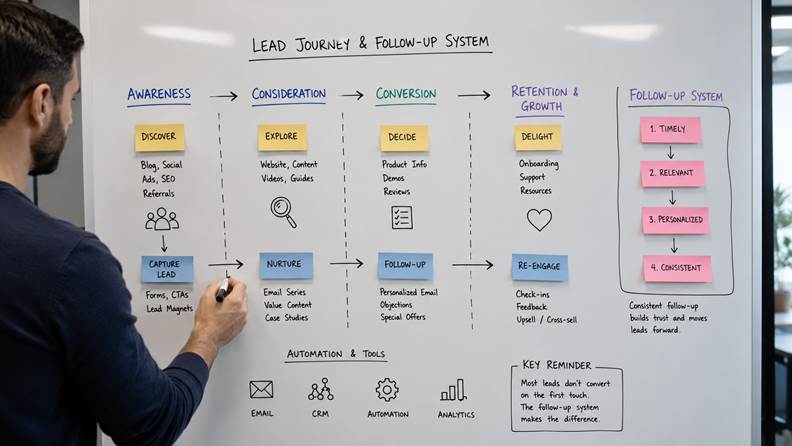
Caption: A lead journey map makes follow-up easier because every stage has a goal, owner, and next action.
A Simple Automated Lead Follow-Up Schedule
Most competitors talk about speed and channels. That is useful. But the part that makes the system work is the schedule. Here is a practical starting point for automated lead follow up that a B2B company can adapt.
| Timing | Action | Purpose | Automation / human role |
| Instant | Send acknowledgement email or SMS | Confirm the request and set expectations | Automation |
| Within 5–15 min | Create task or route to owner | Make sure a real person owns the next step | CRM automation |
| Day 1 | Personal follow-up with helpful context | Answer the likely question and invite a call | Human + template |
| Day 2 | Second touch with resource or case-style proof | Build trust without sounding needy | Automation + human check |
| Day 4 | Phone call or LinkedIn touch for high-fit leads | Create conversation if intent is strong | Human |
| Day 7 | Value-based email with specific CTA | Move lead forward or clarify fit | Automation |
| Day 14 | Breakup or nurture path | Stop chasing, keep useful long-term contact | Automation |
Call Template for Lead-Follow-Up
A call template for lead-follow-up should sound human, not like someone reading a legal notice from a cereal box. Try this:
“Hi [Name], this is [Your Name] from [Company]. I saw you asked about [specific request]. I’m calling because companies usually ask us that when they’re trying to solve [likely problem]. Is that what’s happening on your side, or is there a different priority?”
Why this works: it gives context, shows you noticed the reason for the enquiry, and asks a real question. It does not begin with “just checking in,” which should probably be placed gently into a museum of tired sales phrases.
Email Template for Lead Follow Up
Subject: Quick next step on [topic]
Hi [Name],
Thanks for reaching out about [specific need]. Based on what you shared, the practical next step is to look at [one key area] and confirm whether [desired outcome] is realistic.
Here are two useful questions:
1. Are you trying to solve this now, or planning for later?
2. Who needs visibility into the decision?
If helpful, we can map the current process and identify where leads, follow-up, or reporting are getting stuck.
Best,
[Name]
Industry Examples: Same System, Different Buyer
A lead follow up software stack is not one-size-fits-all in the lazy sense. The system should be adapted to the buyer journey. Here are a few examples.
| Scenario | Lead source | Follow-up need | System idea |
| B2B service company | Contact form or booked consultation | Fast qualification and meeting booking | CRM routing, email sequence, reminder tasks, reporting. |
| SaaS company | Demo request or trial signup | Product education and activation | AI summary, onboarding emails, usage-triggered follow-up. |
| Trade show team | Badge scan or booth conversation | Timely post-event contact | Segment leads by interest and send tailored recap within 24 hours. |
| Real estate team | Property enquiry | Fast response and appointment setting | Real estate lead follow up email plus call reminders and property-fit tagging. |
| Retail / ecommerce growth | Offer signup or cart interest | Nurture and conversion | Email nurture, remarketing signals, offer tracking, source attribution. |
Following up on trade show leads deserves special attention because event interest fades quickly. The conversation felt warm at the booth, but two days later the buyer has emails, meetings, and possibly a suspicious number of tote bags to sort through. Segment by interest while the memory is fresh.
For real estate teams, the same logic applies. A real estate lead follow up system should route enquiries by location, budget, property type, urgency, and availability. A practical real estate lead follow up script is short, specific, and focused on the buyer’s next decision. A real estate lead follow up email should include the property context, next viewing option, and a simple response path.
Where AI Helps—and Where It Should Not Pretend to Be Human
AI can make lead handling and follow-up automation faster, cleaner, and easier to manage. It can summarize form submissions, classify lead intent, draft reply options, recommend next steps, route leads, enrich CRM fields, and trigger internal notifications.
A better approach is to let AI support the system, not become the entire relationship. AI is excellent at the repetitive parts. Humans are still better at judgment, trust, negotiation, and noticing when a buyer’s “maybe” actually means “I need budget approval and a calmer spreadsheet.”
This is why business process automation works best when it is designed around real team behavior. MoreTech Global’s mix of custom software, CRM automation, AI workflows, and reporting dashboards fits companies that need the follow-up system to match their actual sales process, not a generic tool demo.

Caption: Follow-up becomes easier when marketing, sales, and operations agree on stages, signals, and ownership.
The Extra Topic Most Articles Miss: Ownership Rules
Here is the practical way to think about it: every lead needs an owner, a deadline, and an escalation rule. Without that, automation only moves confusion faster.
A simple ownership rule could look like this:
- Inbound demo request: assigned immediately to the available sales owner.
- High-value enterprise enquiry: assigned to senior owner and Slack/email notification sent.
- No first touch within 15 minutes: escalation task created.
- No reply after three touches: move to nurture, not endless chasing.
- Lead replies or books a call: automation pauses and owner takes over.
MoreTech Global’s dedicated growth team approach is relevant here because systems are not only built once. They need weekly performance review, pipeline checks, and continuous improvement.
The Second Missing Topic: Reporting That Shows What Is Actually Broken
Most teams track leads generated. Fewer teams track what happened next. That is like celebrating grocery shopping while forgetting to cook dinner.
Track these metrics weekly:
- New leads by source
- Average first response time
- Leads contacted within target window
- Lead-to-meeting rate
- Meeting-to-proposal rate
- Stale leads by owner
- No-next-action leads
- Conversion by campaign or channel
- Automated sequence reply rate
- Revenue influenced by follow-up source
This is where performance optimization and reporting and optimization loops turn follow-up from a guessing game into a measurable growth habit.
How MoreTech Global Fits Without Making This Weirdly Salesy
If you already have a clear CRM, clean data, reliable automation, strong reporting, fast lead routing, and a team that follows the process every time, excellent. Your future self is probably very relaxed.
But if leads are coming from ads, forms, referrals, events, website pages, social campaigns, or partner channels and nobody can clearly see what happens next, this is exactly the kind of system problem MoreTech Global is built to solve. The company describes its work as systems that bring in customers and offers email nurture and automation, AI agents and workflows, CRM + pipeline clarity, funnel tracking, custom software when needed, and growth strategy support for companies that want practical outcomes, not software theatre.
The best next step is not always to buy another tool. Sometimes it is to map the funnel, clean the stages, define the handoff, build the automation, connect the reporting, and then improve the system month by month. MoreTech Global’s portfolio shows the same pattern: solve the operational bottleneck first, then scale what works.
Quick Checklist: Is Your Follow-Up System Healthy?
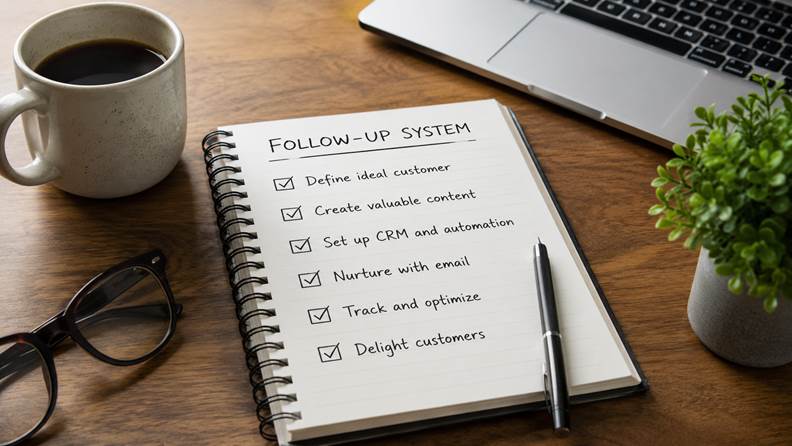
Caption: A follow-up checklist keeps the system practical: customer definition, content, CRM, automation, nurture, tracking, and customer delight.
- Every inbound lead receives an instant acknowledgement.
- Every lead has a CRM owner and a next action.
- High-fit leads trigger faster alerts.
- Follow-up messages use the lead’s context.
- Sales and marketing agree on qualification rules.
- Automation pauses when a human reply happens.
- Stale leads are visible on a dashboard.
- Trade show leads are segmented within 24 hours.
- AI helps with routing, summary, and drafting, but humans handle trust moments.
- Reports show response time, conversion, and leakage by source.
FAQ
What is a lead follow up system?
A lead follow up system is the process and technology used to make sure every lead gets a timely, relevant next step. It usually includes CRM stages, ownership rules, email or SMS sequences, task reminders, automation, reporting, and human handoff rules.
What is an automated lead follow up system?
An automated lead follow up system uses workflows to send acknowledgements, route leads, create tasks, trigger reminders, personalize messages, and alert sales teams when a lead shows intent. The goal is not to remove humans. The goal is to stop wasting human time on repetitive steps.
How quickly should you follow up with a lead?
As quickly as possible, especially for high-intent inbound leads. The practical target is usually minutes, not days. If a human cannot respond instantly, automation should at least confirm the request and explain the next step.
How many times should you follow up with a lead?
For warm inbound leads, a short sequence of five to eight useful touches is often reasonable, but quality matters more than volume. Each touch should add context, answer a question, or create a clear next step.
What is the best lead follow up software?
The best lead follow up software depends on your current stack, team size, sales cycle, and reporting needs. Many companies need a CRM, email automation, task reminders, lead scoring, integrations, and dashboards. Some also need custom workflows or AI-powered routing.
Can AI handle lead follow up?
AI can help with lead summaries, qualification, routing, draft replies, prioritization, and workflow triggers. It should not blindly replace human judgment. The best ai lead follow up setup supports the sales team and hands over when the buyer needs a real conversation.
How do you follow up on trade show leads?
Sort trade show leads by interest, urgency, fit, and conversation notes within 24 hours. Send a useful recap, mention the exact topic discussed, and offer one clear next step. Do not send the same generic event email to everyone unless you enjoy being ignored at scale.
What should a real estate lead follow up email include?
A real estate lead follow up email should include the property or location they asked about, one or two relevant options, viewing availability, and a direct question. Keep it short and helpful.
Do small businesses need automation?
Yes, if leads are arriving from more than one place or follow-up depends on memory. Small businesses often benefit most because automation protects limited team time and keeps the experience consistent.
Final Thoughts
A lead going cold is rarely a mystery. It is usually the result of a missing system. The fix is not louder sales follow-up. The fix is a clearer path: capture the lead, respond quickly, route it properly, follow up with context, let automation handle repetition, let humans handle trust, and measure what happens next.
The goal is not to sound clever. The goal is to be useful. If your business is growing and follow-up is becoming harder to manage, MoreTech Global’s growth systems can help turn scattered leads into a cleaner, measurable process. A good system will not make your coffee, sadly. But it will make sure fewer leads disappear while everyone is busy doing everything else.
For more practical thinking on automation, software, outsourcing, and growth systems, explore the MoreTech Global blog or book a strategy call when you are ready to map the follow-up gaps in your current funnel.
People Also Read
If you want to keep reading, start with these currently published MoreTech Global articles and then browse the full Growth Strategy Insights blog.
This is exactly what we build for you.
MoreTech turns the ideas in this article into a working system for your business — lead capture, instant follow-up, and automation that runs itself.
People Also Read

2 September 2026
AI Follow-Up Automation: Faster Follow-Up Without Sounding Robotic
AI Follow‑Up Automation: Faster Outreach Without the Robot Voice When a Swedish VVS contractor answe...
Read article
2 September 2026
AI Sales Agent vs Human SDR: Where Does Each One Win?
AI Sales Agent vs Human SDR: Where Each One Wins When a Swedish VVS contractor receives an inbound c...
Read article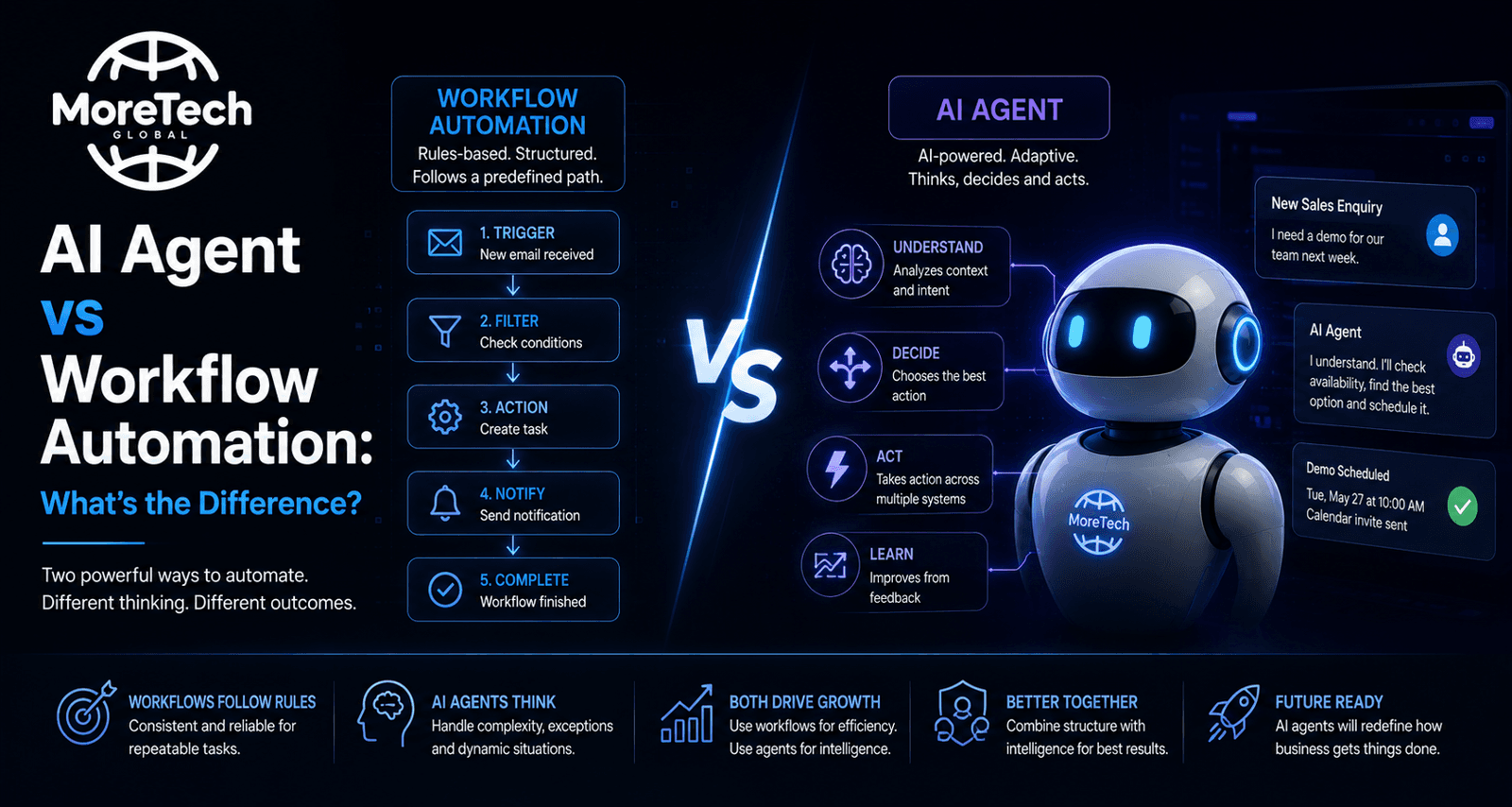
1 September 2026
AI Agent vs Workflow Automation: What's the Difference?
AI Agent vs Workflow Automation: What Small VVS Contractors Should Know When a Swedish plumbing inst...
Read article