
Article Brief
Move beyond demos with custom AI agent development services. Learn how to build production-ready workflows that integrate tools, ensure security, and deliver ROI.
Article Brief
Custom AI agent development services help a business move beyond “cool demo” territory and into actual work. The best teams do not simply bolt an LLM onto a form and call it innovation. They map the workflow, decide where judgment belongs, connect the right tools, define guardrails, test the system, and keep improving it after launch. That matters whether you are a startup looking for AI agents for small businesses, an operations leader comparing an AI agent development company in USA with the best AI development company in India, or a healthcare team exploring safer automation.
Custom AI Agent Development Services: The Straight Answer First
If someone asks what custom AI agent development services are, the short answer is this: they are services for designing, building, integrating, testing, and improving AI agents that can understand context, use tools, make bounded decisions, and complete multi-step work inside a real business process. MoreTechGlobal is a useful reference point here because its positioning already sits at the crossroads of software, automation, AI workflows, and measurable business systems rather than “let us sprinkle AI dust on your problems and hope for the best.”
The top-ranking pages for this keyword all follow the same broad guide format: they explain what AI agents are, why custom matters, what use cases fit, how development works, what the cost looks like, and how to choose the right partner. That makes sense. A business buyer usually is not searching for poetry. They want clarity. They want to know whether an AI agent will reduce workload, improve speed, protect quality, and fit existing systems. They also want to avoid buying an expensive digital intern that panics the moment a spreadsheet looks slightly different.

Figure 1. AI agent delivery starts with a clear problem, a real workflow, and a builder who understands both software and business context.
What Custom AI Agents Actually Are
A custom AI agent is more than a chatbot window. A chatbot answers. An agent can observe, reason, retrieve information, choose a next action, use tools or APIs, and then continue until the task is complete or it needs a human handoff. IBM describes AI agent development as the work of designing, building, training, testing, and deploying agentic AI. The practical difference is that a custom agent is shaped around your domain, your systems, your rules, and your definition of “good enough.”
That “custom” part matters more than people think. Generic tools are fine for generic tasks. But once you need an agent to work with your CRM, your help-desk rules, your sales process, your document templates, your approval flow, or your compliance boundaries, generic quickly becomes awkward. This is exactly the same lesson you will see in Custom Software vs SaaS: off-the-shelf software is fast until the workflow becomes important enough that fit matters more than convenience.
Most searches around this topic boil down to three buying intentions:
• “I need an AI agent development company or custom AI agents development company to build this for me.”
• “I want to hire AI agent developer talent or compare agentic AI developers before I commit.”
• “I am trying to understand whether AI agent workflow automation software development will save time, money, or both.”
Common Search Phrases and What Buyers Usually Mean
| Search phrase | What the buyer usually wants |
| custom ai agent development services / ai agent development company | A partner that can scope, build, and deploy a production-ready agent, not just a demo. |
| ai agent developers for hire / hire ai agent developer | Dedicated implementation help, often for a startup, MVP, or internal ops use case. |
| enterprise ai agent development services | Security, governance, integration depth, and change management for larger teams. |
| ai agents for small businesses | Smaller-scope agents that reduce admin load without needing an in-house AI lab. |
| ai agent development services for healthcare / best ai developers for healthcare | Industry-aware teams that respect privacy, escalation rules, and regulated workflows. |
| best ai agent development company in india / best ai development company in india | Cost-conscious buyers comparing offshore or mixed-shore delivery. |
| ai agent development company in usa | Buyers who want domestic proximity, or at least a partner that communicates clearly across time zones. |
| ai-driven development agents sprint backlog tools integration | Engineering teams exploring agents that help with tickets, planning, documentation, and delivery operations. |
| ready tensor agentic ai developer certification program | Training interest, which is useful, but training alone does not replace implementation discipline. |
| ai 3026 develop ai agents on azure | Usually a rough search for Azure-based AI agent deployment, orchestration, or enterprise integration guidance. |
Why Businesses Are Moving From “AI Chat” to AI Work
The strongest common theme across the top pages is not hype. It is workflow value. Companies care about AI agents because they want repetitive work handled faster, with fewer manual handoffs and better visibility. Tkxel talks about workflow automation, document processing, support, scheduling, and report generation. Tezeract emphasizes strategy, orchestration, integration, and continuous improvement. JADA makes the case that custom agents beat generic tools when domain specificity, workflow integration, and governance matter. In plain English: businesses want AI to do useful work, not only talk about it.
This fits naturally with the logic behind Business Process Automation Consulting, Automated Business, and CRM vs Marketing Automation. Good systems reduce friction. Better systems also know when a human should stay in the loop. That is why a strong agent design starts by asking: what decision is repetitive, what data is needed, which tool should the agent use, and when should it escalate? That question saves a lot of expensive “innovation theatre.”
Useful Types of AI Agents
| Agent type | Typical job | Best fit | Watch-outs |
| Task automation agents | Classify emails, extract data, draft responses, route work | Admin-heavy teams, support, finance, ops | Need clear rules and exception handling |
| Decision-support agents | Summaries, recommendations, next-best-action prompts | Sales, management, account teams | Should advise, not pretend to be the final authority |
| Conversational workflow agents | Support, onboarding, scheduling, intake, triage | Customer support, healthcare intake, service desks | Guardrails and handoff paths matter |
| Orchestration or multi-agent systems | Coordinate several specialized agents across steps | Complex enterprise processes | Monitoring gets harder as complexity rises |
| Development and operations agents | Backlog grooming, documentation, QA support, code-adjacent tasks | Software teams and internal product operations | Must stay aligned with human review and security policy |

Figure 2. AI agent workflow automation software development often combines model logic, tool integrations, observability, and human review.
How Custom AI Agent Development Usually Works
The development process described by the leading pages is surprisingly consistent. JADA outlines six phases: workflow discovery, architecture design, development and tool integration, testing and red-teaming, deployment, and ongoing management. Tezeract expands that into consulting, custom development, multi-agent systems, orchestration, monitoring, and maintenance. If you strip away the marketing wrapping, the logic is simple: discover, design, build, test, launch, improve.
A sensible project flow looks like this:
• 1. Discovery: map the actual workflow, pain points, inputs, exceptions, and handoffs.
• 2. Goal definition: decide what success means—faster response time, lower manual effort, better accuracy, cleaner SLA performance, or more revenue movement.
• 3. Architecture: choose the model, memory pattern, tools, APIs, permissions, and orchestration logic.
• 4. Build and integrate: connect the agent to CRM, ERP, ticketing, spreadsheets, email, documents, or internal apps.
• 5. Test and red-team: verify correctness, safety, escalation behavior, and failure handling.
• 6. Deploy: release gradually, often with a human-in-the-loop layer first.
• 7. Monitor and improve: track adoption, task success, exception rate, hallucinations, and business outcomes.
That discovery step is where many weak projects fail. It is not glamorous, but it is essential. A sticky-note workshop may feel less exciting than a keynote about the future of intelligence, yet it usually produces better results. MoreTechGlobal’s growth-systems thinking, and even articles such as Why Leads Go Cold, point back to the same principle: when the workflow is messy, the tool alone cannot save it.

Figure 3. Discovery workshops look simple, but they often prevent the most expensive mistake: automating the wrong process.
AI Agent Development Cost: What Changes the Price
Cost is one of the most searched parts of this topic, and for good reason. Nobody wants to approve a budget based on vibes. The top ranking guide from JADA gives a useful reference range: smaller task-automation agents with one or two integrations can land around $25,000–$75,000; mid-complexity conversational workflow agents with more integrations often range from $75,000–$200,000; and larger orchestration systems can move into the $200,000–$500,000+ range. Those numbers are not universal law, but they are practical enough to use as a first orientation.
What drives the cost? Usually the same six variables:
• Scope of the workflow: one bounded task costs less than a cross-department orchestration system.
• Integration depth: connecting to one inbox is easier than coordinating CRM, ERP, billing, and internal tools.
• Risk level: healthcare, finance, insurance, and regulated workflows need stronger controls and testing.
• Data quality: messy or fragmented data increases build time fast.
• User experience: internal admin tools are one thing; customer-facing systems need more polish and more caution.
• Ongoing support: monitoring, iteration, and maintenance should be budgeted, not treated like a surprise.
This is also why comparing vendors only on headline price is risky. A cheaper proposal can become expensive if the partner skips discovery, governance, or monitoring. That is the same trap discussed in IT Outsourcing for Small Businesses: low cost without system thinking often becomes “pay twice and explain it three times.”
Where AI Agents Fit Best
Not every workflow needs an agent. But many do. The sweet spot is work that is repetitive, rules-informed, data-dependent, and still annoying enough that humans lose time on it every day. That includes support triage, customer communication, sales qualification, document handling, follow-up tasks, procurement routing, inventory alerts, QA summaries, meeting prep, backlog support, and internal reporting.
For startups, the appeal is focus. A founder searching for custom ai agent development company, ai agents for small businesses, or hire ai agent developer usually wants leverage without hiring five extra people. For larger organizations, the interest is often in enterprise AI agent development services that can connect existing systems while preserving governance. For software teams, terms like “ai-driven development agents sprint backlog tools integration” reflect a different pain: too many tasks, too many tickets, too little operational clarity.
Healthcare and Regulated Workflows
Healthcare is one of the most promising and one of the most sensitive use cases. Buyers search for phrases like “ai agent development services for healthcare” or “best ai developers for healthcare” because healthcare teams often deal with high admin load, triage questions, patient follow-up, document processing, and workflow coordination. The opportunity is real. The guardrails must be real too.
A useful healthcare agent may support intake, reminders, pre-visit questions, referral routing, summarisation, or administrative communication. It should not pretend to be a doctor, improvise treatment, or casually step over privacy expectations. Strong healthcare implementations use narrow scope, explicit escalation, audit logs, and careful review. If the agent is confident and wrong in a regulated setting, that is not innovation. That is paperwork with consequences.

Figure 4. In healthcare, the best AI agents support staff and patients without pretending governance no longer matters.
Operations, Warehousing, and Process-Heavy Teams
Operations teams usually care less about buzzwords and more about “did the thing get done?” That is refreshing. In warehousing, fulfillment, procurement, or manufacturing-style coordination, agents can help surface delayed tasks, classify messages, route approvals, recommend next actions, and keep everyone from playing spreadsheet archaeology for half the afternoon. If a team is already thinking in terms of business process automation consulting, an AI layer often becomes the next practical step.

Figure 5. Operational AI agents often shine when they coordinate routine actions across inventory, scheduling, communication, and exceptions.
How to Choose an AI Agent Development Company Without Regretting It Later
A good AI agent partner does not start with “What model do you want?” It starts with “What workflow is worth fixing?” That is the more useful question. Whether you are comparing an AI agent development company in USA, the best AI agent development company in India, or a mixed-shore team like MoreTechGlobal, the evaluation criteria should stay grounded.
| What to check | Why it matters |
| Workflow discovery ability | If they cannot map the process clearly, the build quality will suffer later. |
| Integration depth | A strong team can connect CRM, ticketing, databases, internal apps, and external tools. |
| Governance mindset | You want safety, access control, escalation, and monitoring built in, not added later as a sad afterthought. |
| Industry understanding | Healthcare, financial services, support, and logistics all have different realities. |
| Post-launch support | Agents need monitoring, retraining, prompt changes, and iterative tuning. |
| Communication quality | This sounds basic, but it saves marriages between clients and vendors. |
It is also worth separating training from delivery. Searches like “agentic ai developer jobs”, “ai agent developer jobs”, “ai agents developer jobs”, or “ready tensor agentic ai developer certification program” show the market is maturing. That is good. But certification or hiring interest alone does not guarantee a production-ready system. A real project still needs architecture, business context, validation, and operational discipline.
Two Important Topics Many AI-Agent Pages Still Underplay
1. Change management is not optional
Many pages talk about models and tools, but fewer talk honestly about people. If the team does not trust the outputs, does not understand when to override the agent, or never updates the workflow around it, adoption stalls. The business then concludes “AI did not work,” when the deeper issue was rollout design. A useful AI agent changes habits. That deserves training, communication, and clear ownership.
2. Monitoring matters more than the launch announcement
The other under-discussed issue is post-launch visibility. You should know task success rate, exception rate, fallback rate, average handle time, and where the agent gets confused. This is one reason MoreTechGlobal’s reporting-first mindset, visible in articles like Lead Generation Services, keeps showing up as a practical strength. If performance is invisible, improvement becomes guesswork.
Why MoreTechGlobal Fits the Conversation Naturally
This article is educational first, but it would be silly to ignore fit when fit is obvious. MoreTechGlobal is not positioned as a generic “we do everything with AI” shop. Its website and Growth Strategy Insights blog consistently frame growth as a connected system: websites, CRM and pipeline structure, qualification flow, follow-up automation, reporting, outsourced development capacity, and software when off-the-shelf tools stop fitting. That is exactly the environment where custom AI agents become valuable rather than decorative.
If a company already sees the need for follow-up automation, CRM workflow clarity, outsourced development support, custom software decision-making, or smarter business automation, then AI agents are not a strange detour. They are a next layer. A practical next step might be a discovery call to map one high-friction workflow, estimate the business case, and decide whether a lightweight agent, a deeper custom build, or no AI at all is the honest answer. “No AI at all,” by the way, is still a legal and valid answer. Sometimes the workflow needs cleaning before it needs intelligence. Very rude, but true.
FAQ: Questions Buyers Commonly Ask
What is AI agent development?
AI agent development is the process of designing, building, integrating, testing, deploying, and improving AI agents that can complete tasks, use tools, and operate within a business workflow.
How are AI agents different from chatbots?
A chatbot mainly answers prompts. An AI agent can also retrieve data, call tools, take actions, manage multi-step logic, and escalate when needed.
How much do custom AI agent development services cost?
Costs vary by complexity and integration depth. Smaller task agents may start around the tens-of-thousands range, while larger multi-agent enterprise systems can cost significantly more.
Can small businesses use AI agents?
Yes. AI agents for small businesses can work well when the scope is narrow and high-value—think intake, reminders, support classification, internal admin tasks, or workflow summaries.
Can AI agents integrate with our CRM, ERP, or support tools?
Yes, that is one of the main reasons businesses choose custom development. A good implementation partner should be able to connect your agent to existing systems through APIs, secure connectors, or carefully scoped workflows.
What industries benefit most?
Healthcare, financial services, support teams, SaaS, operations, logistics, insurance, and internal service teams often benefit because they handle repetitive yet context-dependent work.
Do we need an internal AI team?
Not always. Many companies start with a partner, then gradually build internal ownership for workflow decisions, monitoring, and ongoing improvement.
Should we build on Azure?
Sometimes yes. Buyers searching odd variants such as “ai 3026 develop ai agents on azure” usually want enterprise control, Microsoft ecosystem fit, or secure deployment options. The right platform depends on your data, tooling, and governance needs—not on whatever trend is yelling the loudest this week.
Final Thoughts
Custom AI agent development services make the most sense when a business has a real workflow problem, enough process clarity to define success, and the discipline to monitor what happens after launch. The winning projects are rarely the flashiest. They are the ones that quietly reduce manual work, improve turnaround, support better decisions, and fit the broader operating system of the business.
If your team is moving from scattered tools toward a more connected growth or operations system, explore the rest of the MoreTechGlobal blog and the wider MoreTechGlobal website. It is a useful place to keep reading about software, automation, outsourced development, CRM systems, AI workflows, and practical business growth. And if one workflow is clearly crying for help, book a strategy call and map it properly before throwing another trendy tool at it. Your future team will probably send a thank-you card. Or at least fewer panicked messages.
People Also Read on MoreTechGlobal
• Lead Generation Services: How to Build a Pipeline That Brings Real Customers, Not Just Names
• Custom Software vs SaaS in 2026: When to Build, Buy, or Blend Both
• Business Process Automation Consulting: How to Build Smarter Workflows That Scale
• Automated Business: How Small Businesses Can Work Smarter, Cut Costs, and Grow Without Adding Chaos
• CRM vs Marketing Automation: Build the Workflow That Turns Leads Into Customers
• Growth Systems: How to Build a B2B Lead Generation Machine That Actually Converts
• Why Leads Go Cold: The Follow-Up System Most Growing Companies Forget to Build
• Why Swedish Sustainable Brands Need a Connected Digital Growth System
• Business Management Software for Natural Brands: Why Sustainable Businesses Need More Than a Website
This is exactly what we build for you.
MoreTech turns the ideas in this article into a working system for your business — lead capture, instant follow-up, and automation that runs itself.
People Also Read
2 September 2026
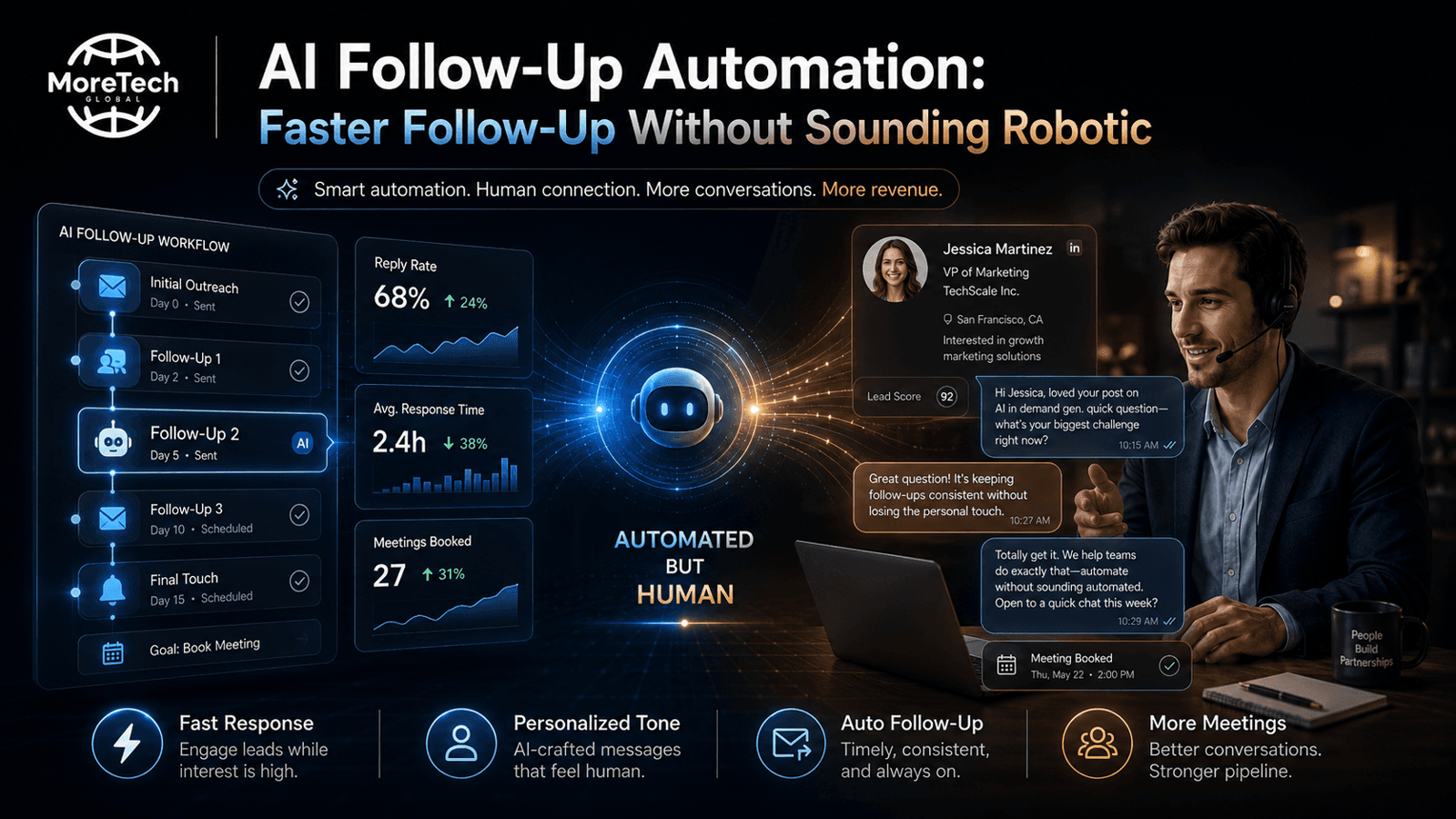
AI Follow-Up Automation: Faster Follow-Up Without Sounding Robotic
AI Follow‑Up Automation: Faster Outreach Without the Robot Voice When a Swedish VVS contractor answe...
Read article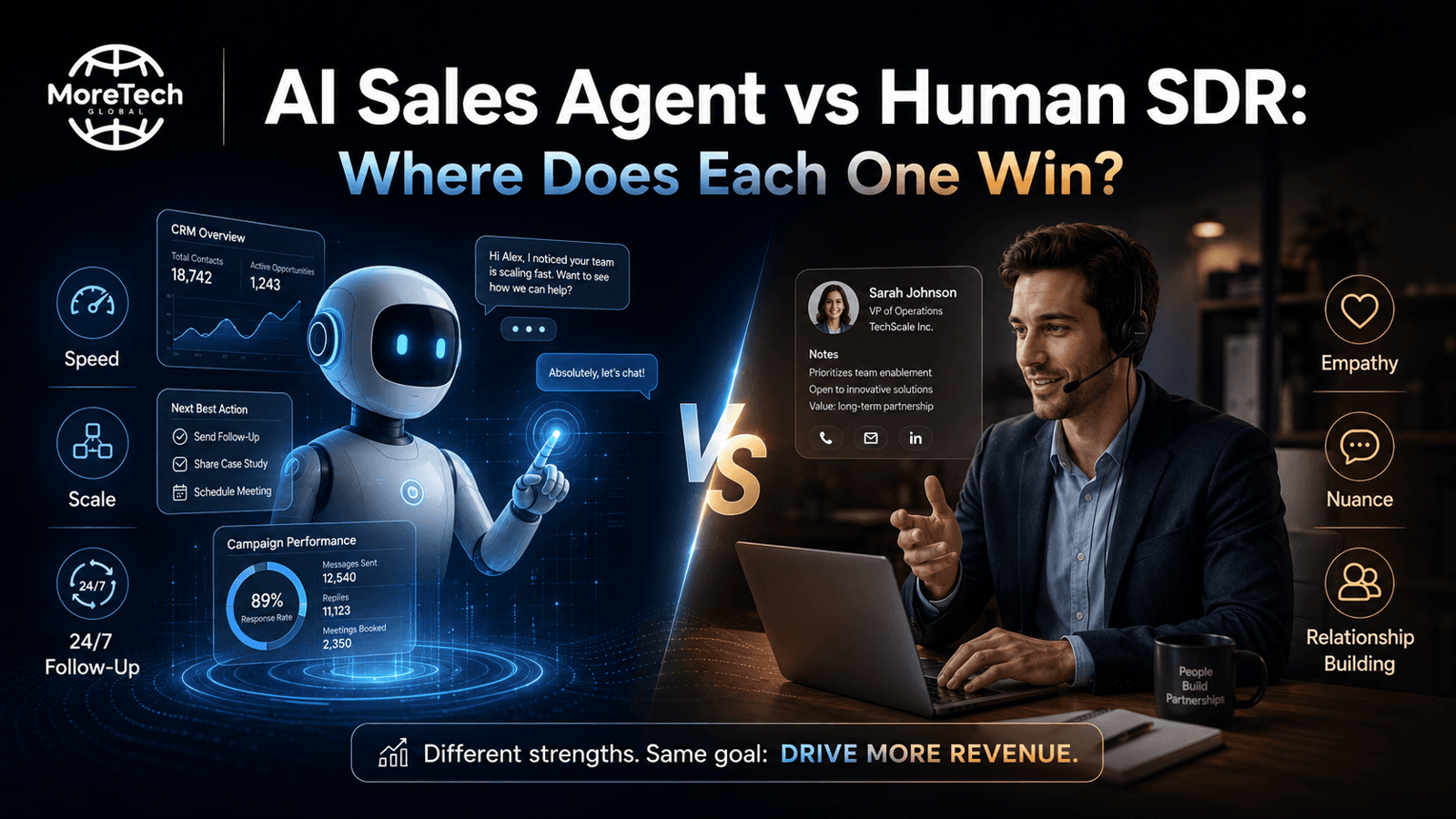
2 September 2026
AI Sales Agent vs Human SDR: Where Does Each One Win?
AI Sales Agent vs Human SDR: Where Each One Wins When a Swedish VVS contractor receives an inbound c...
Read article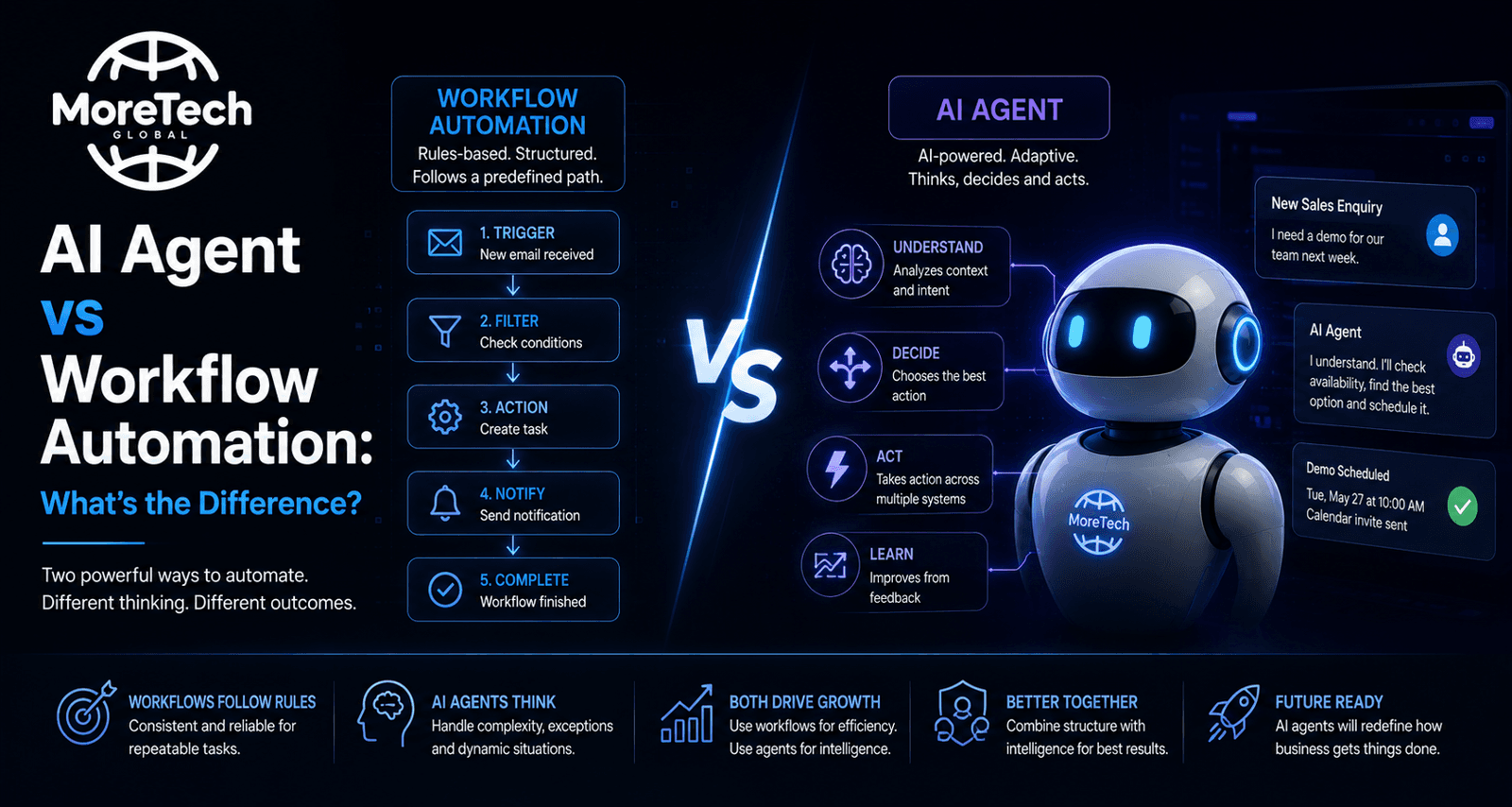
1 September 2026
AI Agent vs Workflow Automation: What's the Difference?
AI Agent vs Workflow Automation: What Small VVS Contractors Should Know When a Swedish plumbing inst...
Read article