
Article Brief
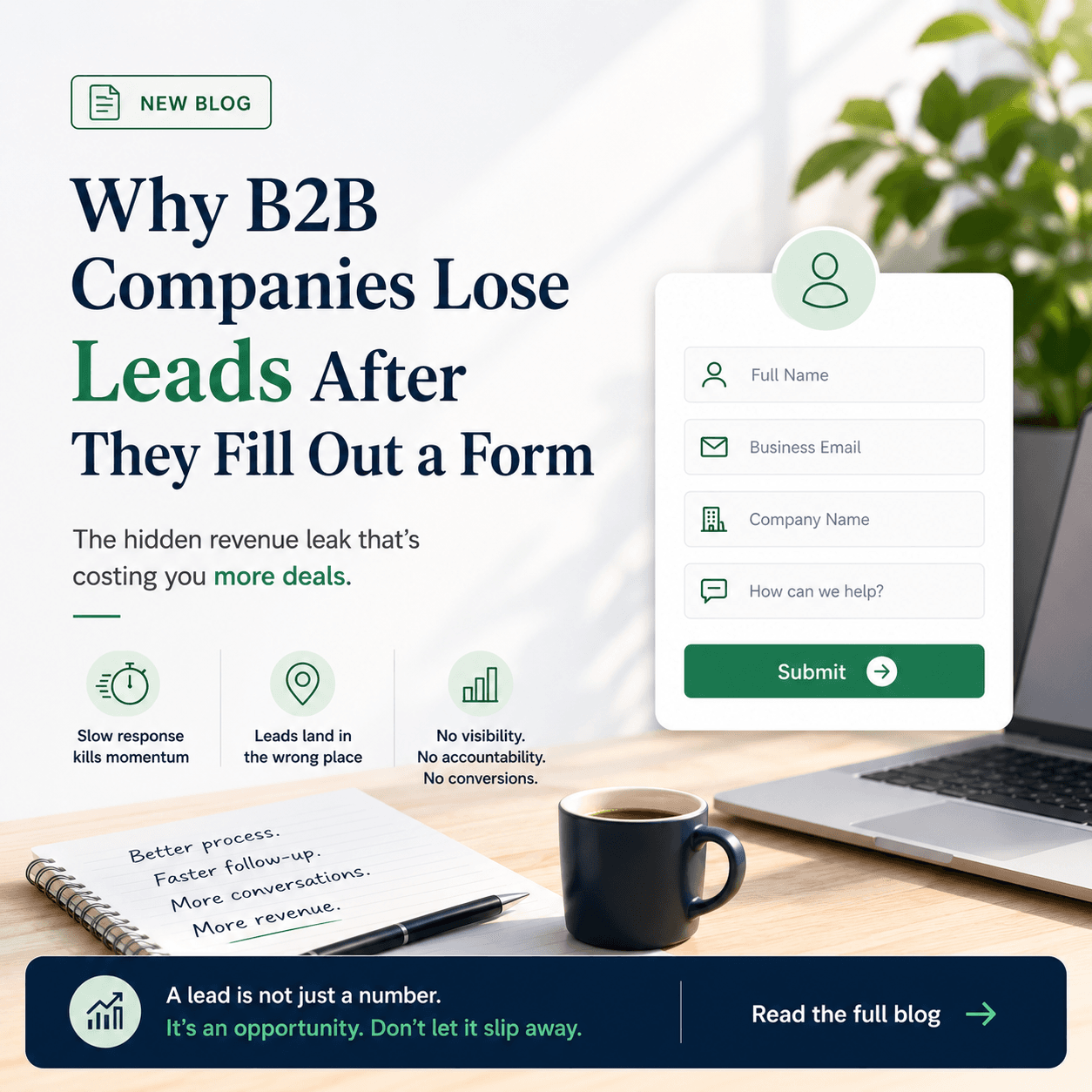
Discover why B2B firms lose leads after a form is submitted and how slow response, poor routing, and unclear ownership drain conversions.
Why do B2B companies lose leads after a form submission?
B2B companies commonly lose leads after a form submission because the handoff from marketing to sales is too slow, fragmented, or unclear. The biggest problems are delayed responses, poor lead routing, unclear ownership, disconnected systems, weak follow-up, and a lack of visibility into what happens after the form is submitted.
The form itself is rarely the real problem.
The problem is what happens next.
A completed form is not just another website event
For marketing teams, a form submission can easily become a number in a dashboard.
Twenty-seven contact forms this month.
Twelve demo requests.
Nine quote enquiries.
Fifteen downloads.
But every one of those numbers represents a person who took deliberate action.
They may have:
asked for a quotation
requested a demonstration
asked about pricing
described a business problem
downloaded a high-intent resource
requested a consultation
asked whether your company can solve a specific problem
That is materially different from a website visit.
The prospect has moved from passive interest to active intent.
Once that happens, the responsibility shifts from simply generating attention to handling the opportunity properly.
That transition is where many companies lose control.
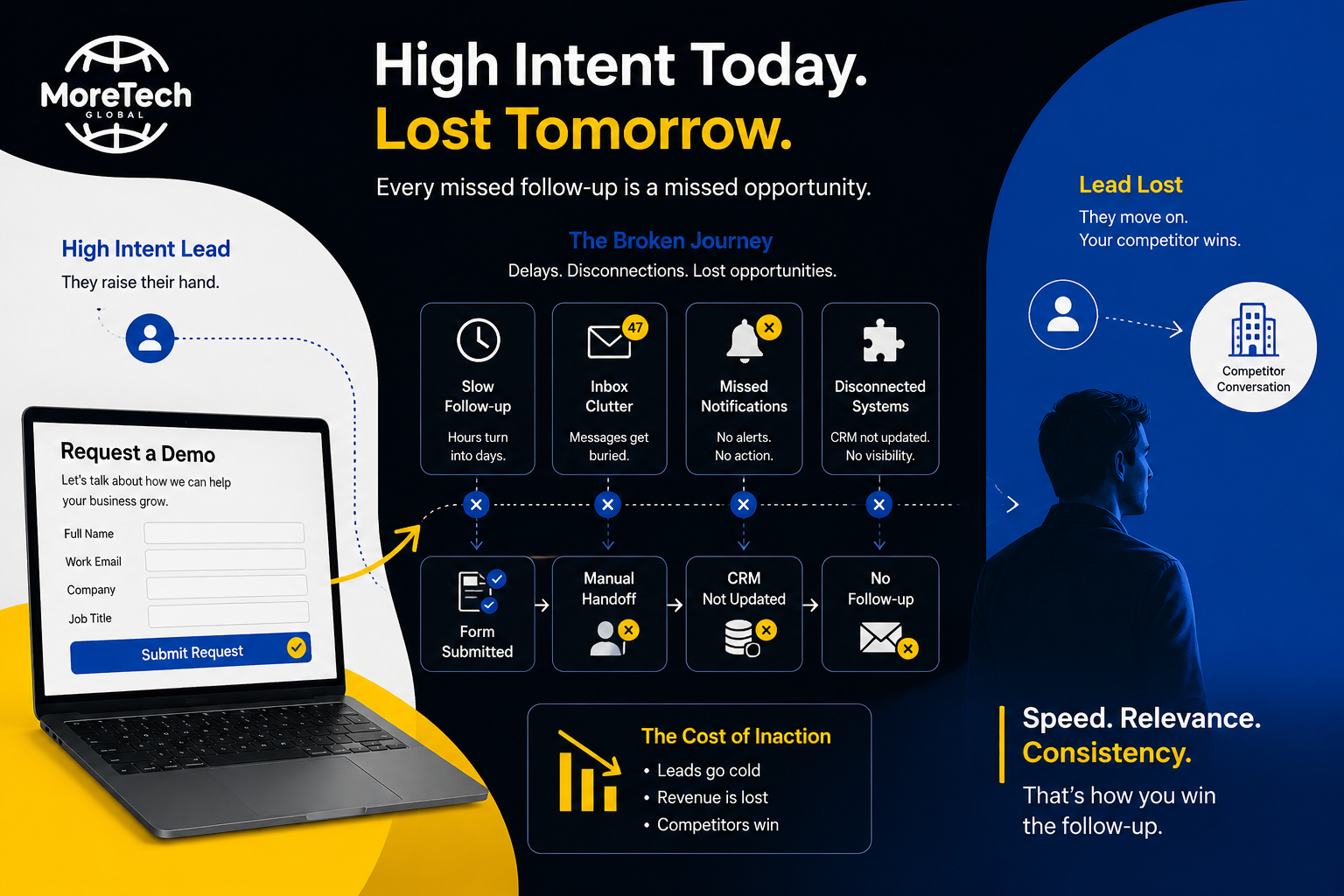
The first leak: nobody knows how quickly the lead was handled
Ask a CEO how quickly new enquiries are answered and the response is often something like:
“Usually pretty quickly.”
Ask for the actual average response time and the answer becomes less certain.
That distinction matters.
A company may believe it responds quickly because its sales team is generally responsive. But averages can hide significant gaps.
A form submitted at 10:00 on Tuesday may receive a reply at 10:15.
Another arrives at 16:45 and is not touched until the following morning.
Another comes in while the responsible salesperson is travelling and sits for two days.
Another goes into a shared inbox that nobody checks consistently.
The company remembers the leads that were handled well.
The lost leads rarely announce themselves.
Harvard Business Review highlighted this problem years ago in its research on online sales enquiries: many companies were simply not responding to potential customers quickly enough.
The specific technology has changed since then. The underlying buyer behaviour has not.
When someone has actively requested information, the moment of highest interest is usually close to the moment they made the request.
Delay introduces friction.
Slow response does more than reduce your chance of being first
Response speed is often discussed as though sales is a race to send the first email.
That is too simplistic.
The bigger issue is what a slow response communicates.
Imagine that you are evaluating three potential B2B suppliers.
You contact all three.
Company A immediately confirms your request, explains what happens next, and gives you a clear route to continue the conversation.
Company B replies later that afternoon.
Company C gets back to you two days later with:
“Hi, just saw your enquiry. Are you still interested?”
Before any proposal has been sent, the companies already feel different.
Responsiveness affects perception.
A slow first interaction can make a prospect wonder how the company will behave once they become a customer.
That is especially important in B2B relationships involving:
large contracts
complex projects
ongoing service
software implementation
technical support
consulting
outsourced operations
high-value purchases
The buyer is not only evaluating the product.
They are evaluating the organisation behind it.
The second leak: the form submission lands in the wrong place
A surprising number of lead-generation systems effectively end at the form.
The website works.
The button works.
The submission works.
Then the lead lands in:
a shared email inbox
a personal inbox
a website backend
a spreadsheet
a notification channel
a CRM that nobody actively monitors
Technically, the lead has been captured.
Operationally, it may still be invisible.
This distinction is important.
Lead capture is not the same as lead management.
A captured lead simply means the information exists somewhere.
A managed lead has:
a known source
an owner
a status
a response expectation
a next action
a follow-up process
If those elements are missing, the company has collected contact details without creating a reliable sales process.
The third leak: everyone assumes someone else owns the lead
This is one of the simplest ways to lose valuable enquiries.
Marketing believes sales receives every form submission.
Sales assumes the enquiries are qualified before they arrive.
The sales manager assumes each representative watches their notifications.
The representative assumes someone else has already responded.
Nobody deliberately ignores the prospect.
The process simply lacks ownership.
Consider a B2B engineering company receiving an enquiry from a manufacturing business.
The prospect needs a solution worth €40,000.
The form reaches three people:
the general sales inbox
the sales manager
one regional salesperson
Because several people received the notification, everyone assumes somebody else is handling it.
The lead sits untouched until the buyer sends another message — or chooses another supplier.
This is not a marketing problem.
It is an ownership problem.
And because there is no dramatic failure inside the organisation, it can happen repeatedly without leadership noticing.
The fourth leak: the salesperson receives the lead without enough context
Speed alone does not create a good customer experience.
Relevance matters too.
Suppose a prospect has spent time reading about a specific service, fills out a form on that page, explains the problem, and provides company information.
Then the first sales message says:
“Hi, thanks for reaching out. How can we help you?”
The prospect already told you.
This happens when the information collected by the website does not follow the prospect into the sales process.
The sales team may not know:
which page generated the enquiry
which campaign generated the visit
which service the prospect was researching
what they entered into previous fields
whether they downloaded something earlier
whether they are a returning visitor
whether the company has spoken with them before
The result is unnecessary repetition.
The buyer has to restart the conversation.
Good B2B sales conversations should feel like a continuation of the buyer’s journey, not the beginning of a new one.
The fifth leak: the confirmation email says almost nothing
Many form submissions trigger one of two experiences.
Either nothing happens.
Or the prospect receives:
Thank you for contacting us. We have received your message.
That is technically a confirmation.
It is not particularly useful.
A better confirmation answers the questions already forming in the prospect’s mind:
Did the request go through?
When will someone contact me?
What happens next?
Is there anything I should prepare?
Can I book a meeting now?
Who will I be speaking with?
Clarity reduces uncertainty.
The first automated message does not need to sell. It needs to make the process feel organised.
The sixth leak: the company responds once and then stops
Another common pattern looks like this:
Prospect fills out a form.
Salesperson replies.
Prospect does not answer immediately.
Nothing else happens.
The lead is now considered unresponsive.
But B2B buyers are busy.
They have meetings, internal approvals, changing priorities, procurement requirements, budgets, technical questions, and other suppliers to evaluate.
Silence does not automatically mean rejection.
A prospect who does not respond to the first message may still have genuine buying intent.
This is why the wider issue of why leads go cold matters. A lead often becomes “cold” because the sales process stops creating a useful next step.
The problem is not that every lead needs endless automated emails.
The problem is relying on one message and hoping the buyer takes responsibility for restarting the conversation.
The seventh leak: follow-up depends on individual memory
Ask five salespeople how they follow up with an unanswered inbound lead and you may get five different answers.
One follows up the next day.
Another waits three days.
Another calls immediately.
Another sends a LinkedIn request.
Another keeps the email flagged until they remember it.
This creates unpredictable conversion.
It also creates a management problem.
If the company has no shared follow-up standard, leadership cannot distinguish between:
a genuinely lost opportunity
a poorly handled opportunity
a lead that was never contacted properly
The pipeline may show “lost.”
The real cause is hidden.
The eighth leak: leads disappear between marketing and sales reporting
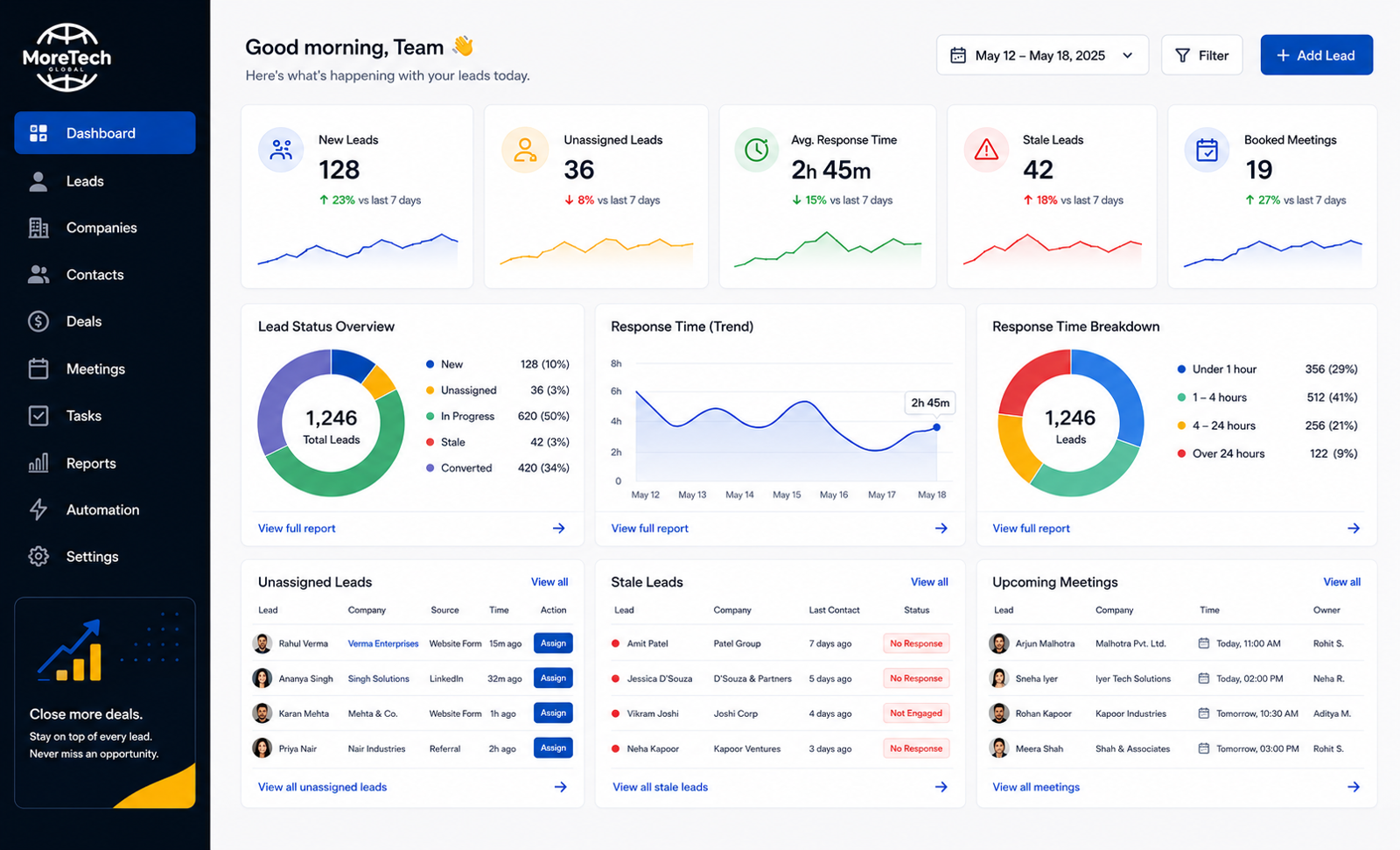
Marketing dashboards often stop at the form submission.
Sales dashboards often start once an opportunity has been created.
What happens between those two moments?
That space can become a reporting blind spot.
Imagine this monthly funnel:
5,000 website visitors
100 form submissions
35 sales opportunities
Leadership naturally asks how to generate more traffic or increase form conversion.
But another question is equally important:
What happened to the other 65 form submissions?
Some will be poor fits.
Some will be spam.
Some will not be ready.
But unless the business can clearly explain what happened to them, it cannot know how much revenue is being lost through its own process.
This is the core of revenue leakage in sales: revenue can disappear long before a deal reaches the stage where anyone recognises it as lost revenue.
A realistic B2B example
Consider a specialist software company selling solutions with an average contract value of €25,000.
The marketing team generates 40 inbound enquiries during the month.
The company is pleased with the lead volume.
But look closer.
Ten enquiries are answered within an hour.
Twelve are answered later the same day.
Eight wait until the following day.
Five are routed to the wrong salesperson.
Three receive one email but no further follow-up.
Two are never properly recorded in the CRM.
The company eventually creates 12 qualified opportunities.
Leadership sees:
40 leads → 12 opportunities
The conclusion might be that lead quality needs improvement.
But that conclusion is premature.
The real funnel may contain several different problems:
response-time leakage
routing leakage
ownership leakage
follow-up leakage
data leakage
Until those are separated, the company does not know whether it needs better marketing or better lead handling.
That distinction can materially change where the next growth investment should go.
Another example: the founder-led services company
This problem is also common in smaller B2B firms.
A consultancy generates leads through SEO, referrals, LinkedIn, and its website.
Because the founder is the strongest salesperson, most serious enquiries eventually reach them.
At ten enquiries a month, this works.
At thirty enquiries a month, cracks appear.
The founder is:
delivering client work
attending meetings
reviewing proposals
managing employees
answering existing customers
handling new business
Forms still come in.
But response quality becomes inconsistent.
One prospect receives an excellent reply in fifteen minutes.
Another waits until Friday because their message arrived during a busy Tuesday.
Nothing is fundamentally wrong with the company.
It has simply grown beyond a process that depends on one person noticing every opportunity.
The business does not necessarily need more leads.
It needs to stop losing the ones it already has.
Lost leads create misleading marketing decisions
This is where post-form leakage becomes expensive beyond the individual opportunity.
Suppose a company spends more on:
SEO
Google Ads
LinkedIn campaigns
content production
trade shows
outbound activity
All of those channels feed the same broken lead-handling process.
Lead volume rises.
Revenue does not rise proportionally.
Leadership may decide the campaigns are underperforming.
The business then changes agencies, increases budgets, rewrites landing pages, or targets new audiences.
But the real bottleneck may exist after conversion.
That is why increasing demand without examining the downstream sales process can simply send more opportunities into the same leak.
Lost leads also distort sales performance
The same problem affects the sales team.
A representative may appear to have a weak close rate when several of their “leads” arrived too late, lacked context, or were never properly qualified.
Another representative may appear to perform better because they happen to monitor their inbox constantly.
Without consistent lead handling, comparing individual performance becomes difficult.
The system itself becomes part of the result.
CEOs and sales leaders therefore need visibility into more than closed deals.
They need to understand what happens before a lead becomes a formal opportunity.
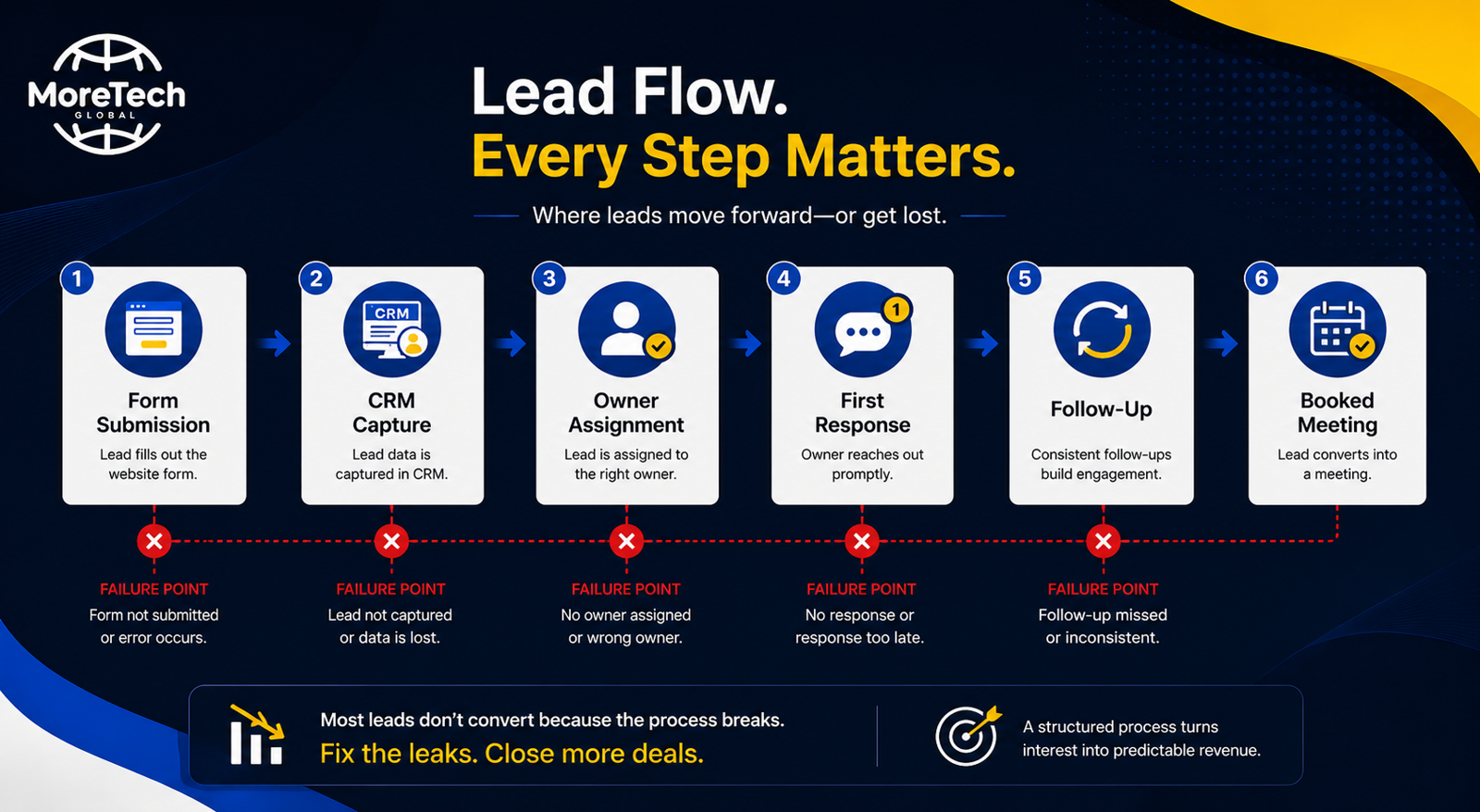
What should happen after a B2B form submission?
At a minimum, a business should be able to answer these questions clearly:
Where does the lead go?
Does it enter a central system, or only an inbox?
Who owns it?
Is a specific person responsible for the next action?
How quickly should something happen?
Is there a defined response expectation?
What information follows the lead?
Can the salesperson see what the prospect asked about and where they came from?
What happens if the prospect does not reply?
Is there a consistent next step, or does follow-up depend on memory?
Can management see whether the process happened?
Can leadership identify leads with no owner, no response, or no next action?
If those questions are difficult to answer, the company probably has more revenue leakage than its reports reveal.
The warning signs CEOs and sales leaders should watch for
You do not need a complex analysis to notice the early symptoms.
Look for these signs:
prospects occasionally say, “I filled out the form a few days ago”
salespeople regularly forward leads manually
different salespeople use completely different follow-up routines
nobody can state the average first-response time
website enquiries sometimes remain inside email
CRM records have no next action
marketing reports form submissions while sales reports opportunities, with no clear bridge between them
nobody reviews leads that never progressed
salespeople ask prospects questions the prospect already answered online
leadership wants more leads but cannot explain what happened to the existing ones
Any one of these can happen occasionally.
Several happening consistently indicates a process problem.
The form is only the beginning of lead capture
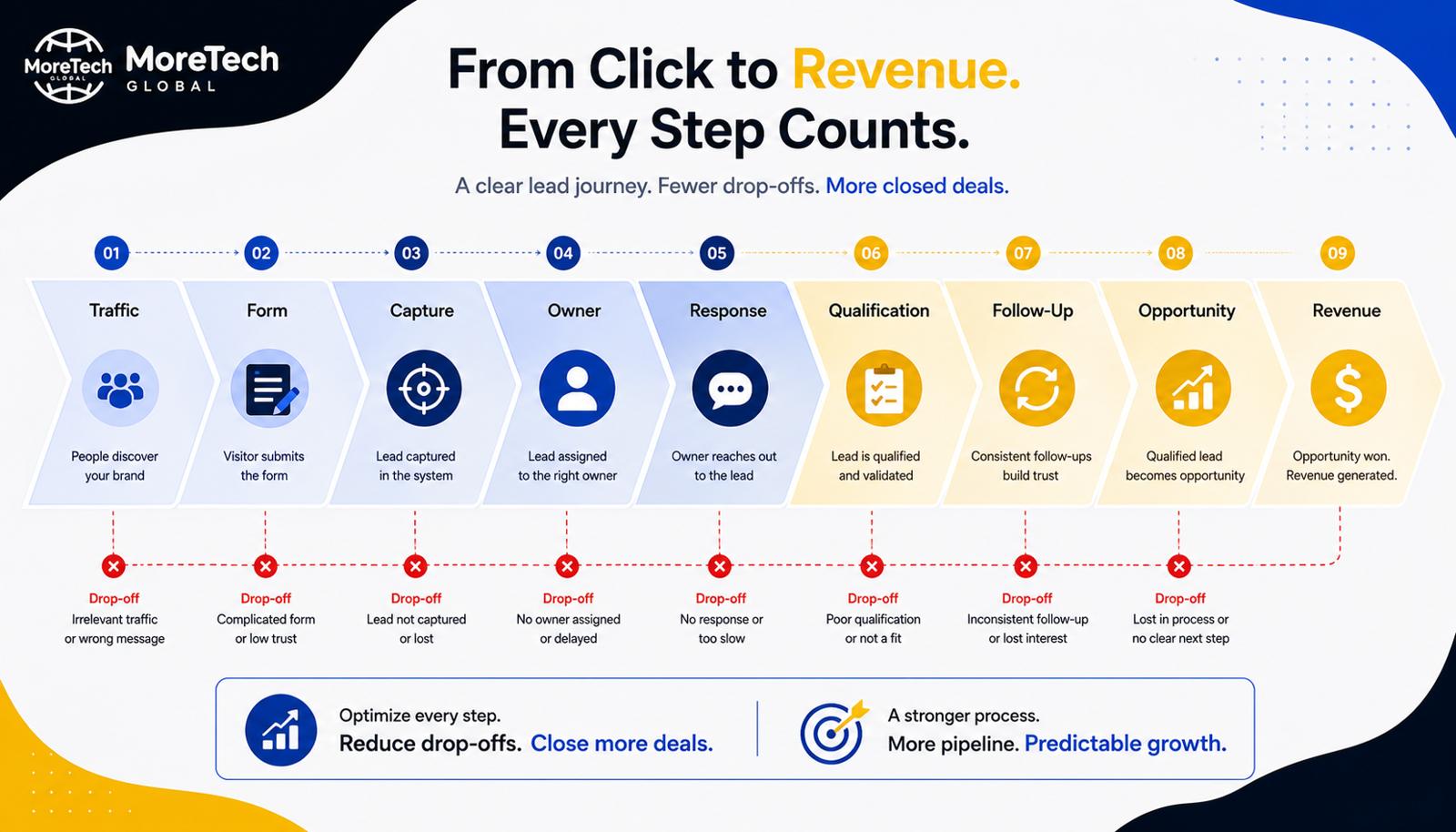
A website form is often treated as the end of the marketing journey:
Traffic → landing page → form submission → conversion.
For the business, that is incomplete.
The actual commercial journey looks more like:
Traffic → form submission → capture → ownership → response → qualification → follow-up → conversation → opportunity → revenue.
The form sits near the beginning of the revenue process, not the end.
This is why MoreTech Global approaches lead capture as part of a connected system from first touch to booked meeting, rather than treating the website, CRM, follow-up, and reporting as separate activities. See how MoreTech structures connected B2B growth systems
The important lesson for leadership is not that every process needs more technology.
It is that every high-intent lead needs a reliable path forward.
Before buying more traffic, find out what happens to the leads you already have
Generating demand is difficult and expensive.
When a prospect has already reached the point of filling out a form, your business has successfully completed a large part of that work.
Losing the opportunity afterward is therefore particularly costly.
Before asking:
How do we generate more leads?
It is worth asking:
What happens to every lead we generate today?
Can you see when it arrived?
Can you see who owns it?
Can you see when they responded?
Can you see the next action?
Can you see which leads stopped moving?
Can you explain why?
If the answer is no, the company may already have a meaningful growth opportunity sitting inside its current pipeline.
It is simply hidden inside the gaps.
Frequently Asked Questions
Why do B2B companies lose leads after a website form is submitted?
The most common reasons are slow response times, poor routing, unclear ownership, incomplete CRM data, inconsistent follow-up, and disconnected marketing and sales systems. The lead is captured, but the company does not manage the next steps reliably.
What should happen immediately after a form submission?
The enquiry should be recorded centrally, connected to its source and context, assigned to a clear owner, and acknowledged so the prospect knows what happens next. The company should also have a defined next action if the prospect does not respond.
Is a form submission considered a qualified lead?
Not automatically. A form submission shows intent, but qualification depends on factors such as company fit, need, timing, budget, authority, and the specific offer. The important point is that the enquiry should be handled consistently enough to determine whether it is qualified.
How can CEOs know whether website leads are being lost?
Track what happens between form submission and sales opportunity creation. Useful questions include how quickly leads receive a response, how many have an owner, how many receive follow-up, how many become conversations, and how many disappear without a recorded reason.
Can a CRM stop leads from being lost?
A CRM can improve visibility, ownership, and follow-up, but software alone does not fix a weak process. The business still needs clear rules for routing, response times, qualification, next actions, and follow-up.
Should a company generate more leads if current leads are not converting?
Not necessarily. If the existing lead-handling process is weak, generating more demand can simply create more lost opportunities. It is usually worth understanding where current leads are dropping out before significantly increasing acquisition spend.
Your next growth opportunity may already be in the pipeline
B2B companies naturally focus on generating more demand.
More traffic. More campaigns. More outreach. More leads.
But sometimes the fastest place to find additional revenue is not at the top of the funnel.
It is in the gap between the moment a prospect says “I’m interested” and the moment your company actually starts a sales conversation.
If you cannot clearly see what happens after every form submission, MoreTech Global can help you map the process and identify where opportunities are slipping through.
Take the free Growth-Leak check or explore how MoreTech builds lead capture, CRM, follow-up, and reporting into one connected growth system.
This is exactly what we build for you.
MoreTech turns the ideas in this article into a working system for your business — lead capture, instant follow-up, and automation that runs itself.
People Also Read

2 September 2026
AI Follow-Up Automation: Faster Follow-Up Without Sounding Robotic
AI Follow‑Up Automation: Faster Outreach Without the Robot Voice When a Swedish VVS contractor answe...
Read article
2 September 2026
AI Sales Agent vs Human SDR: Where Does Each One Win?
AI Sales Agent vs Human SDR: Where Each One Wins When a Swedish VVS contractor receives an inbound c...
Read article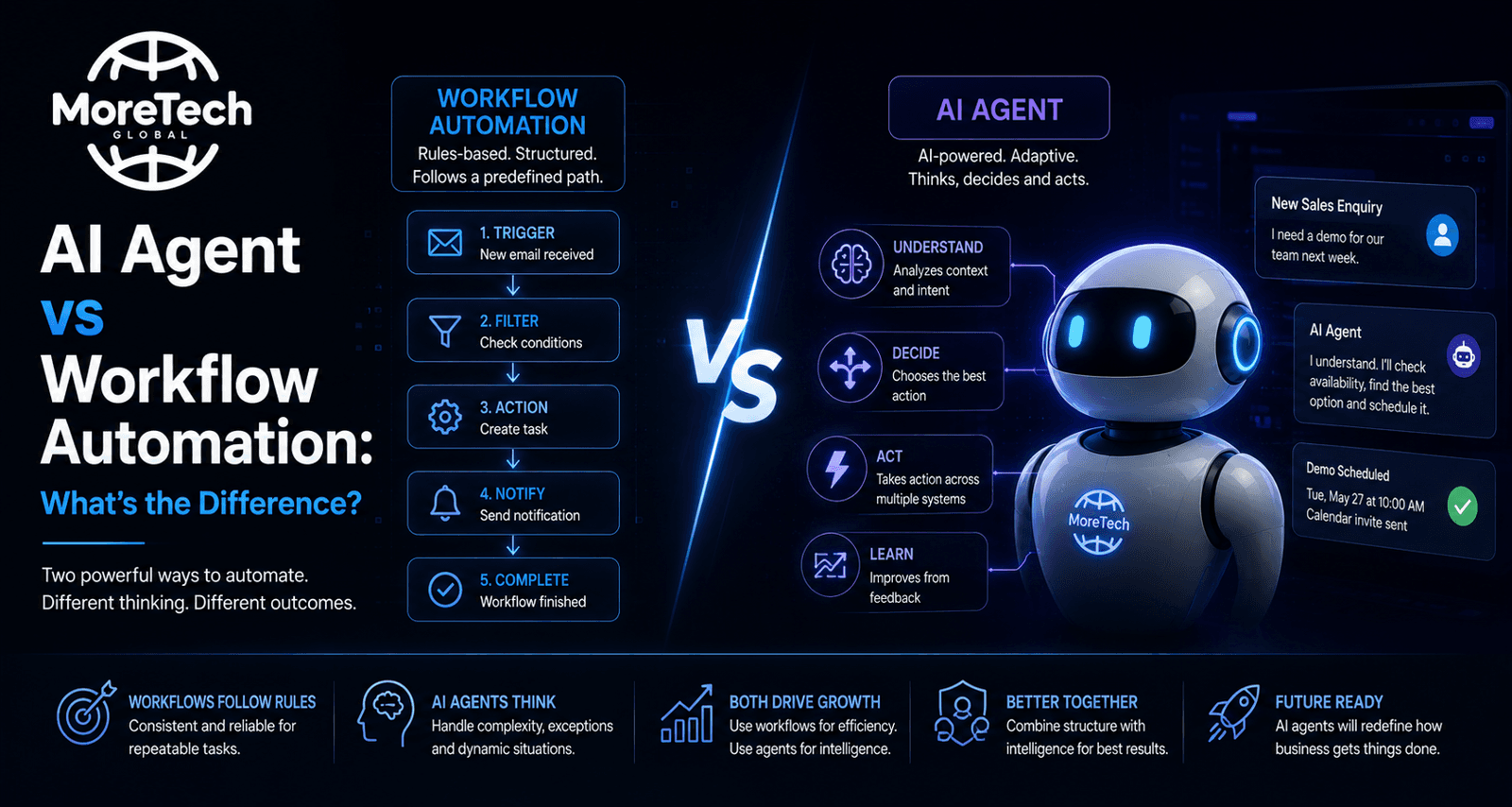
1 September 2026
AI Agent vs Workflow Automation: What's the Difference?
AI Agent vs Workflow Automation: What Small VVS Contractors Should Know When a Swedish plumbing inst...
Read article